Skip to content
Top-rated outdoor gear, ranked

Best Of 2026

Best Boating Anchors of 2026

Our top 10 picks, independently ranked. Budget to premium.

Updated

An anchor is the cheapest insurance a boater ever buys, and the most over-bought. For a weekend pontoon, a center-console, or a 30-foot cruiser, the right anchor is less about brute weight than about how reliably it sets on the first try, how it handles the bottom you actually anchor in, and whether it resets when the wind clocks around at 2 a.m. Recreational boaters tend to anchor in a narrow set of conditions (sand, mud, and the occasional grassy or rocky cove), so the "best" anchor for most people is not the same as the biggest one in the West Marine bin.

The market splits cleanly into generations. Traditional fluke (Danforth-style), claw (Bruce-style), and plow (Delta) anchors have anchored boats for decades and remain the value workhorses. The new-generation "scoop" anchors (Rocna, Mantus, Manson Supreme, Spade), were engineered in the last twenty years and consistently out-set and out-hold the old designs in independent testing, at a real price premium. For a small skiff or a tender you may want neither: a folding grapnel or a box anchor stows flat and is all the holding you need in light conditions.

This guide spans that whole spread, from a $25 folding grapnel for a jon boat to a $700 galvanized scoop for a coastal cruiser. The goal is to help you place yourself on the curve, to understand what an extra $300 actually buys, and where it buys you nothing your bottom conditions will ever notice.

Rocna Vulcan (Galvanized)
Best OverallPremium

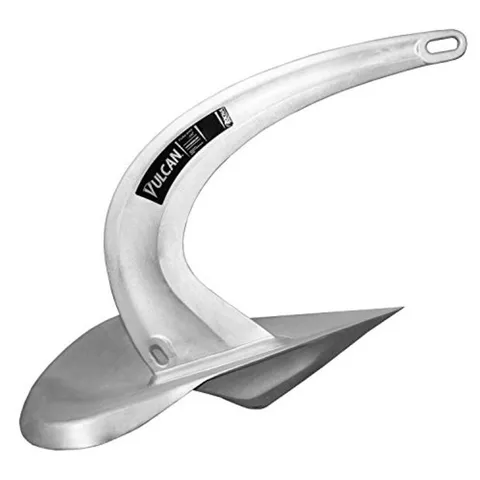
1. Rocna Vulcan (Galvanized)

Rocna

$330–$780

A new-generation scoop anchor without the roll bar, so it self-launches cleanly over almost any bow roller while still setting fast and digging deep across sand, mud, and weed. It's the do-everything pick most cruising boaters land on.

Best for: Cruisers and coastal boaters who want one anchor that just works everywhere

Sets quickly and resets reliably on a wind shift · Roll-bar-free shape fits standard bow rollers and stows well · Excellent holding across mixed bottoms

Premium price for the galvanized version · Heavier sizes are a meaningful investment vs. a Delta

Sources: rocna.com, defender.com, amazon.com

Lewmar Galvanized Delta Fast-Set Anchor
Best ValueMid-range

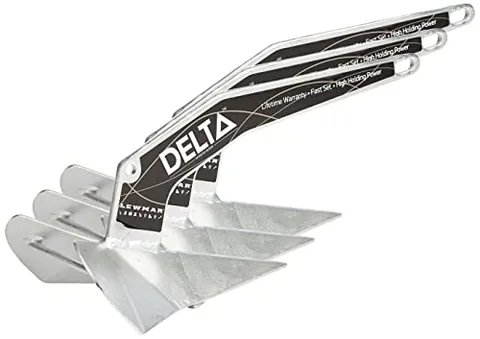
2. Lewmar Galvanized Delta Fast-Set Anchor

Lewmar

$130–$400

The plow that launched a thousand bow rollers. The Delta sets quickly, self-launches without moving parts, and handles sand, mud, and some grass at a price that undercuts every scoop anchor.

Best for: Owners of 20–35 ft boats who want proven all-round holding without paying scoop-anchor money

One-piece design self-launches and stows on a bow roller · Sets fast and holds well in common bottoms · Strong value for the performance

Holding per pound trails new-generation scoop anchors · Less sure on grass and rock than a Rocna or Mantus

Sources: lewmar.com, westmarine.com, defender.com, amazon.com

Mantus M1 (Galvanized)
Best PremiumPremium

3. Mantus M1 (Galvanized)

Mantus Marine

$180–$520

A roll-bar scoop anchor with an aggressive sharp toe that, in independent tests, set faster and deeper than most rivals. It bolts together in three pieces, so it ships flat and disassembles for storage.

Best for: Cruisers who want maximum set-and-hold confidence and value packability

Among the fastest-setting and hardest-holding anchors tested · Three-piece bolt-together design stows flat and re-galvanizes easily · Large fluke area per weight aids penetration

Roll bar can foul some bow rollers · Premium price; multi-piece build is a bit fussier than one-piece anchors

Sources: mantusmarine.com, westmarine.com, windyhq.com, amazon.com

Fortress FX-11 Aluminum Anchor
Editor's PickMid-range

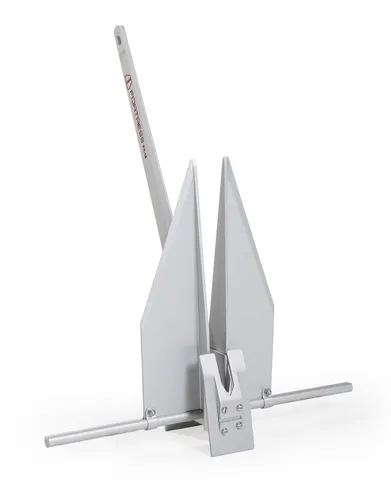
4. Fortress FX-11 Aluminum Anchor

Fortress

$190–$260

An aluminum fluke anchor that delivers enormous holding power in sand and mud for its featherweight, the FX-11 is rated for 28–32 ft boats yet weighs just 7 lbs and disassembles for storage. The ideal stern hook or stowable second anchor.

Best for: Boaters wanting a lightweight, high-holding primary or backup anchor for sandy/muddy anchorages

Exceptional holding-to-weight in sand and mud · Light, rust-proof aluminum; breaks down flat for storage · Adjustable fluke angle for soft vs. hard bottoms

Light weight can make it harder to set in grass or hard bottom · Like all flukes, poor in rock and on a sharp reset

Sources: fortressanchors.com, amazon.com, defender.com

Manson Supreme (Galvanized SHHP)
Premium

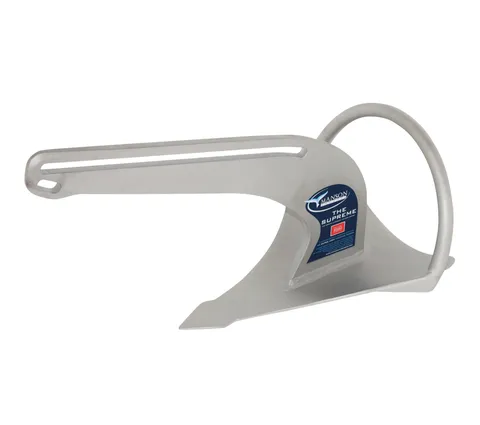
5. Manson Supreme (Galvanized SHHP)

Manson Anchors

$200–$600

A super-high-holding-power scoop anchor with a roll bar and a slotted shank that aids retrieval if the anchor fouls. A direct, well-regarded alternative to the Rocna with the same dig-deep, reset-reliably character.

Best for: Cruisers who want a roll-bar scoop anchor with a built-in fouled-anchor retrieval slot

Certified super-high-holding-power (SHHP) rating · Slotted shank helps free a snagged anchor · Sets fast and resets well across bottoms

Roll bar may not suit every bow roller · Premium pricing in larger sizes

Sources: mansonanchors.com, petersmith.net.nz, amazon.com

Rocna Original (Galvanized)
Premium

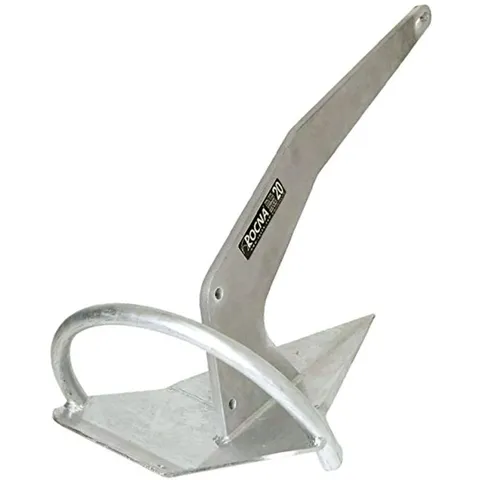
6. Rocna Original (Galvanized)

Rocna

$290–$780

The roll-bar original that made Rocna's reputation. Where the Vulcan trades the roll bar for bow-roller friendliness, the Original keeps it for the most aggressive, foolproof setting, a benchmark cruising anchor.

Best for: Cruisers wanting the most aggressive-setting scoop anchor and a compatible bow roller

Roll bar forces a reliable first-try set · Deep, concave fluke gives top-tier holding · Excellent reset behavior on wind and tide shifts

Roll bar can interfere with some bow rollers · Premium price, especially in heavier sizes

Sources: rocna.com, defender.com, shop.hamiltonmarine.com

Lewmar Claw Anchor (Galvanized)
Mid-range

7. Lewmar Claw Anchor (Galvanized)

Lewmar

$60–$300

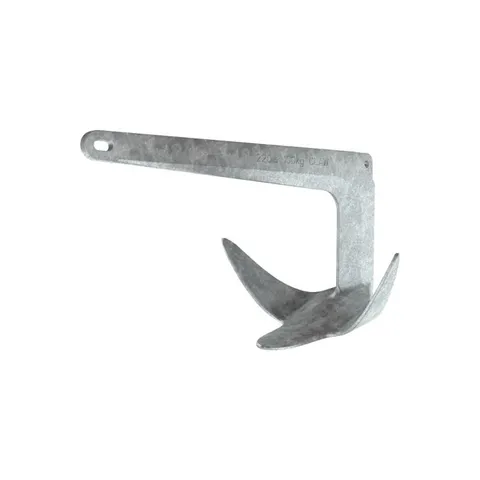
A Bruce-style claw that sets easily and resets well in a wide range of bottoms, including rock and coral where flukes fail. It's the forgiving, inexpensive all-rounder that's hugely popular on recreational boats.

Best for: Boaters who anchor in varied or rocky bottoms and want easy, forgiving setting

Sets in mixed bottoms: rock, coral, sand · Resets quickly with boat swing · Durable one-piece galvanized build at a low price

Modest holding power per pound, needs more weight · Bulky three-claw shape doesn't stow flat

Sources: defender.com, westmarine.com, boatsailmag.com

Slide Anchor Box Anchor (Small)
Mid-range

8. Slide Anchor Box Anchor (Small)

Slide Anchor

$150–$250

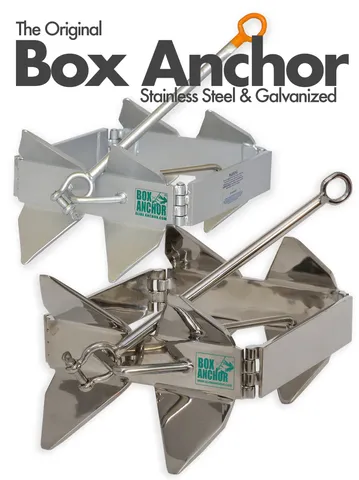
A fold-flat box anchor that bites into nearly any bottom, sets with far less scope than a traditional anchor, and resets itself when wind or current shifts. A favorite of pontoon and deck-boat owners who anchor in open water.

Best for: Pontoon, deck-boat, and runabout owners who want a stow-flat anchor for open-water bottoms

Sets in almost any bottom and holds at short scope · Folds flat for easy storage · Self-resets on wind and current changes

Heavier and pricier than a comparable fluke · Awkward to handle and deploy by hand vs. a fluke

Sources: slideanchor.com, wakemakers.com

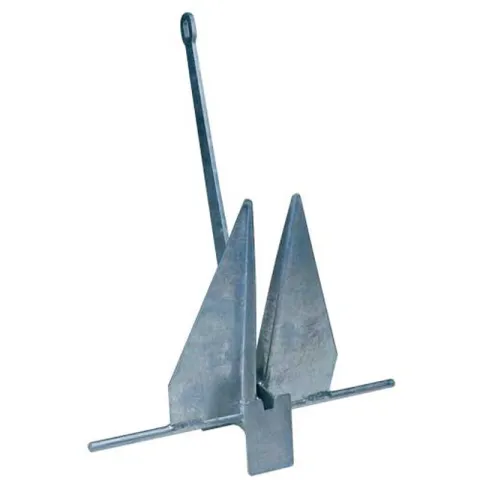
West Marine Traditional Fluke Anchor (Galvanized)
Best BudgetBudget

9. West Marine Traditional Fluke Anchor (Galvanized)

West Marine

$42–$130

The classic Danforth-style galvanized fluke at a house-brand price. In the sand and mud most boaters actually anchor in, it offers excellent holding per dollar and folds flat in an anchor locker.

Best for: Budget-minded boaters who anchor mainly in sand or mud

Outstanding holding per pound in sand and mud · Folds flat for compact stowage · Very inexpensive across sizes

Poor in grass, rock, and on a hard reset · Can skip across hard bottoms before setting

Sources: westmarine.com

Seachoice Folding Grapnel Anchor Kit (3.5 lb)
Budget

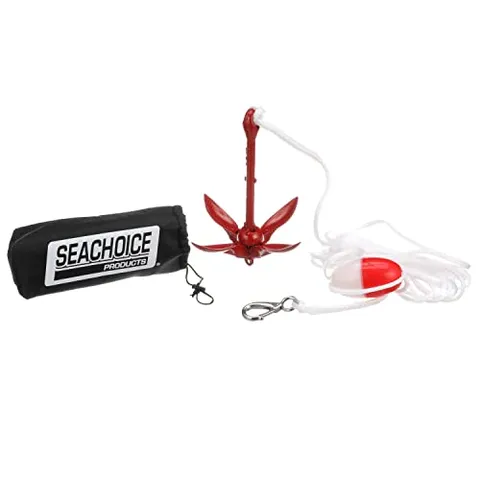
10. Seachoice Folding Grapnel Anchor Kit (3.5 lb)

Seachoice

$20–$45

A complete small-craft anchor kit (folding grapnel, 25 ft of line, buoy, clip, and storage bag), for kayaks, canoes, dinghies, and jon boats. The four collapsing tines fold against the shaft to stow in almost no space.

Best for: Kayak, canoe, dinghy, and small-skiff owners needing a compact, affordable anchor

Folds compact for tiny storage spaces · Complete kit with line, buoy, and bag included · Inexpensive and rust-resistant galvanized steel

Holding is light, for small craft and calm conditions only · Tines can snag and be hard to free in rock

Sources: amazon.com, homedepot.com

How we choose

We ranked anchors by overall recommendation for typical recreational boaters and small-craft owners (weighting first-set reliability, holding power per pound, performance across mixed bottoms (sand, mud, grass, rock), reset behavior on a wind shift, stowage, and value at real US street prices), not by weight or price alone. Tiers reflect price and engineering generation: budget covers traditional fluke, grapnel, and box anchors that hold well in their element for well under $150; mid covers proven plow, claw, and aluminum-fluke designs in the roughly $130–$400 range; premium covers the new-generation scoop anchors (Rocna, Mantus, Manson) whose concave flukes and weighted toes set faster and hold harder, at $200–$800-plus for recreational sizes. Pricing varies widely by anchor size, so each range spans the weights most common on recreational boats; always size to your boat and ground tackle, not to a tier. This guide is editorially independent: we accept no payment from manufacturers for placement, rankings reflect our own reading of independent anchor tests and retailer specs, and any retailer links may earn a commission that does not influence the picks.

Common questions

The common rule of thumb is about one pound of anchor per foot of boat for a primary anchor, but that's only a starting point. Holding power matters more than weight, a new-generation scoop or a fluke anchor can out-hold a heavier claw of the same size. Follow the manufacturer's boat-length-and-weight chart for your specific model, size up if you anchor in strong current or wind or use the anchor overnight, and remember that adequate chain and scope (5:1 to 7:1 rode-to-depth) often matter more than another few pounds of metal.

Fluke (Danforth-style) anchors give the best holding per pound in sand and mud and stow flat, but struggle in grass, rock, and on a hard reset. Claw (Bruce-style) anchors set easily in mixed bottoms including rock and reset well but have modest holding per pound. Plow/Delta anchors are a versatile all-rounder that self-launches over a bow roller. New-generation scoop anchors (Rocna, Mantus, Manson Supreme) set fastest, dig deepest, and reset best across the widest range of bottoms, they're the upgrade most cruisers eventually make. Match the type to the bottom you anchor in most.

Galvanized hot-dipped steel is what most recreational boaters should buy: it's far cheaper, has excellent strength, and resists corrosion well, the trade-off is that the zinc coating eventually wears and can be re-galvanized. Stainless costs two to three times as much and is chosen mainly for the polished look on a bow roller; it offers no meaningful holding advantage. Aluminum (as in Fortress anchors) is a third path, very light for its holding power and rust-proof, but it can be harder to set in hard or grassy bottoms.

You need some chain. A length of chain between the anchor and the rope (nylon) rode lowers the angle of pull so the anchor digs in instead of skipping, and it protects the line from abrasion on the bottom. A common recreational setup is a boat-length of 1/4" or 5/16" galvanized chain spliced to nylon three-strand. A windlass and an all-chain rode are worth it on larger cruisers; smaller boats are fine with a chain-and-rope combination.

Anchors like the Rocna, Mantus, and Manson Supreme are the product of modern testing and are engineered with concave "scoop" flukes, weighted toes, and (on some) roll bars that force the anchor to set on its first try and dig deeper under load. Independent tests repeatedly show them setting faster and holding more than traditional designs of equal weight. For occasional fair-weather anchoring in sand you may never need that margin; for overnight stays, exposed anchorages, or peace of mind, it's the single biggest reliability upgrade in your ground tackle.

Not usually. For kayaks, dinghies, jon boats, and small skiffs, a folding grapnel (3.5–7 lb) or a compact box anchor is the right tool: it holds plenty in light wind, folds or collapses to stow in a small space, and costs a fraction of a primary anchor. Step up to a fluke or box anchor as you move into a 16–24 ft fishing boat or pontoon, where wind load and the desire to hold position over a spot become real.

Some links are affiliate links, and we may earn a commission at no extra cost to you. It never affects our rankings.

In your pocket

Take every launch with you.

Free, no account needed. Ramps, marinas, marine conditions, and maps in your pocket.

  • Every marina and boat ramp in your pocket

  • File a float plan and ETA before you cast off

  • Harbor and inlet webcams before you tow

  • GPS tracking that keeps recording beyond cell coverage

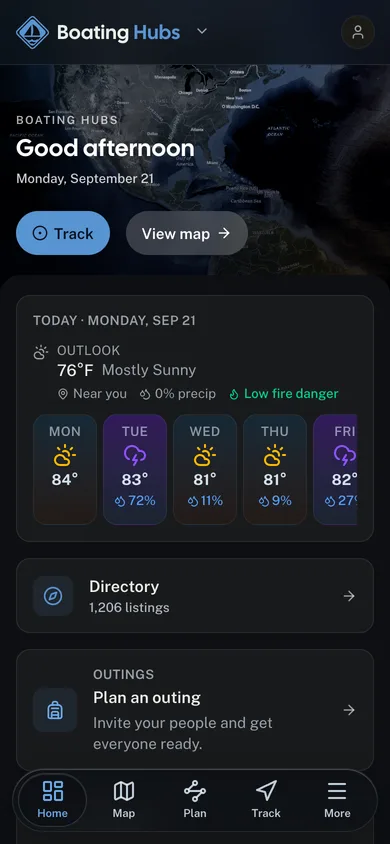
The Boating Hubs app dashboard

For operators

Run your boating business?
Launch your branded surface.

Get your own branded surface in the Boating Hubs app and a directory listing in minutes. Bookings, digital waivers, and your whole operation live in one cockpit.