Skill drill
How to Tie a Clove Hitch
Two turns round a piling or rail with the end tucked under the crossing: the quick way to make a line fast to a post for a short time.
5 steps, about 3 minutes
Tie it in 3D one decision at a time. Choose wrong and you will watch the line come free.
When to use it
Tying up to a piling for a short stop, hanging a fender from a rail, or making a line fast to a post. California's boating course and the Corps of Engineers both call it a temporary tie for small boats, so back it up for anything longer.
The steps
- Round the post
- Cross and go round again
- Tuck the end
- Pull it taut
- Back it up
A drill is practice. Tie each knot a few times at the dock before you rely on it.
The written guide
Step by step
- 1
Round the post
Pass the end of the line round the post, so the turn comes back across the standing part.[1, 4, 5]
The first turn is half the hitch. On its own it holds nothing; the second turn and the tuck are what lock it.
- 2
Cross and go round again
Cross over the first turn and take the end round the post a second time, in the same direction as the first.[1, 4, 5]
The second turn has to go the same way as the first. America's Boating Club's guide says to make it in the same direction and to cross over the first wrap so the second lies on top of it.
- 3
Tuck the end
Pass the end under the second turn where it crosses, so it comes out beside the standing part, heading the other way.[1, 2, 4, 5]
That tuck is what turns two loose wraps into a hitch. The two ends leave from under the same crossing, in opposite directions.
- 4
Pull it taut
Pull the hitch taut. On the back of the post, the two wraps should lie parallel and tight.[1, 4]
A clove hitch left loose can work itself out. The Coast Guard's handbook says one that is not tied tight enough may come undone.
- 5
Back it up
For anything longer than a short stop, lock the clove hitch with half hitches round the standing part.[1, 2, 4, 5, 6]
A clove hitch can slip if the line is not kept under steady pull, or if the post lets it turn. Every boating source here backs it up for longer stays: the Coast Guard with a half hitch, California, Boat Ed and America's Boating Club with two.
Avoid these
Common mistakes
Leaving a boat on it for hours
It is a temporary hitch. California's course says to lock it with two half hitches for longer periods, and Discover Boating says never to use it for heavy-duty jobs like securing a boat to a dock.[2, 3, 5]
Second turn the wrong way
Both turns go round in the same direction, the second crossing over the first.[4]
Stopping at one turn
One turn and a tuck is a single half hitch, which the Coast Guard warns may slip easily.[1]
Watch & learn
Clove hitch on video
Picked from our video library. These are other creators' videos, so where one differs from the drill, the drill's sourced steps are the ones to follow.
Know Your Knots: Clove Hitch | BoatUS
BoatUS
0How to Tie a Clove Hitch Knot | BoatUS
BoatUS
0Master Boating with These 3 Essential Knots!
Live2Boat
0
Keep practicing
Other boating knots
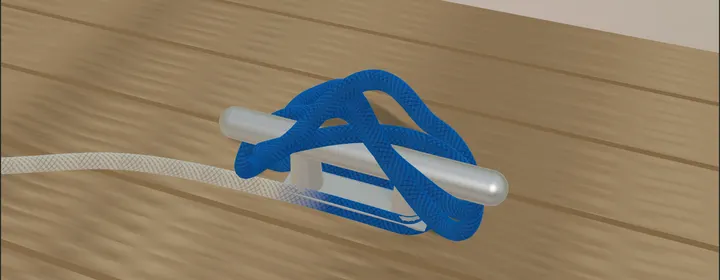 Start hereCleat hitchThe knot for tying up at a dock: a turn round the base of the cleat, a figure eight over the horns, and a locking hitch to finish.4 steps
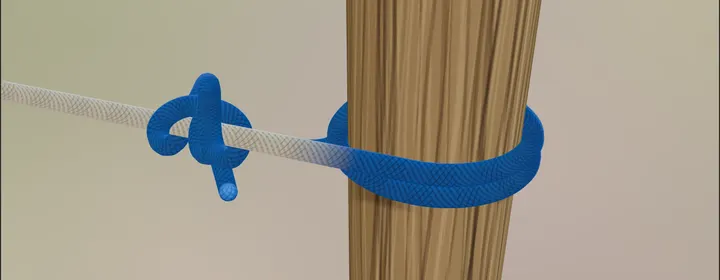 Technique 3Round turn and two half hitchesTwo turns round a post, piling, rail or ring, then two half hitches round the standing part: a secure tie that can be started while the line is already pulling.4 steps
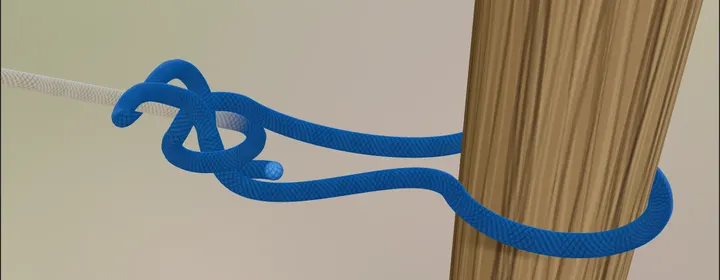 Technique 4BowlineA fixed loop in the end of a line that will not slip or jam and unties easily, even after a heavy load. Here, dropped over a piling.5 steps
Learn it hands-on
Nothing beats a day on the water with someone who ties these every trip. Browse charter and lesson operators near you and ask them to show you.
Find charters and lessonsSources
Where the checkable claims above come from. Rules and figures change, so confirm anything you are about to rely on against the source itself.
- Boat Crew Handbook: Seamanship Fundamentals (BCH 16114.4)U.S. Coast Guard (hosted by the Coast Guard Auxiliary) (rdept.cgaux.org)
- California Boating Safety First: A Course for Safe BoatingCalifornia State Parks, Division of Boating and Waterways (dbw.parks.ca.gov)
- "Knot Safe": Basic Knot Tying and UsageU.S. Army Corps of Engineers (corpslakes.erdc.dren.mil)
- Knots to Know: Clove hitchAmerica's Boating Club (boatingcompass.org)
- 5 Basic Boating Knots for BeginnersDiscover Boating (National Marine Manufacturers Association) (discoverboating.com)
- Types of Nautical Knots (Indiana Boater Safety Course)Boat Ed (Kalkomey Enterprises) (boat-ed.com)