Skill drill
How to Tie a Cleat Hitch
The knot for tying up at a dock: a turn round the base of the cleat, a figure eight over the horns, and a locking hitch to finish.
4 steps, about 3 minutes
Tie it in 3D one decision at a time. Choose wrong and you will watch the line come free.
When to use it
Making a dock line, mooring line or anchor rode fast to a horn cleat. America's Boating Club notes it can be untied even under load.
The steps
- Start at the far horn
- Turn round the base
- Figure eight
- Lock it
A drill is practice. Tie each knot a few times at the dock before you rely on it.
The written guide
Step by step
- 1
Start at the far horn
Lead the line to the horn farthest from the boat, and take it under that horn first.[2, 3, 4]
America's Boating Club says to wrap the line under the horn farthest from the load to take the stress off the line, and the Corps of Engineers deck says the same.
- 2
Turn round the base
Take a turn round the base of the cleat, under both horns.[1, 2, 3, 5]
The turn round the base takes the load before any figure eight goes on. The Coast Guard's handbook calls for a complete turn; America's Boating Club describes a partial one.
- 3
Figure eight
Lead the line over the top of the cleat and under the far horn, then back over the top and under the near horn: a figure eight across both horns.[1, 2, 3, 4]
The figure eight uses both horns, which is what holds. Discover Boating warns against wrapping round one horn: you must use both sides.
- 4
Lock it
Finish with a locking hitch: a half hitch turned under and dropped over the horn, so the end comes away from the cleat in the opposite direction.[2, 3, 4, 5]
The locking hitch holds the figure eight in place. America's Boating Club says to flip the locking loop away from, not toward, the line coming in.
Avoid these
Common mistakes
Wrapping only one horn
Discover Boating sees people get lazy and wrap round one horn. Use both sides of the cleat.[4]
Burying the cleat in turns
Extra figure eights and hitches do not make it stronger. They only slow down casting off.[2]
Flipping the lock the wrong way
Turn the locking loop away from the line coming in, not toward it.[3]
Watch & learn
Cleat hitch on video
Picked from our video library. These are other creators' videos, so where one differs from the drill, the drill's sourced steps are the ones to follow.
How to Tie a Cleat Hitch Knot | BoatUS
BoatUS
0Master Boating with These 3 Essential Knots!
Live2Boat
04 Essential Boating Knots
BoatBuy
0
Keep practicing
Other boating knots
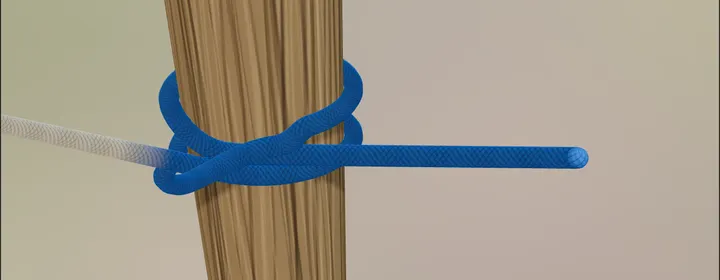 Technique 2Clove hitchTwo turns round a piling or rail with the end tucked under the crossing: the quick way to make a line fast to a post for a short time.5 steps
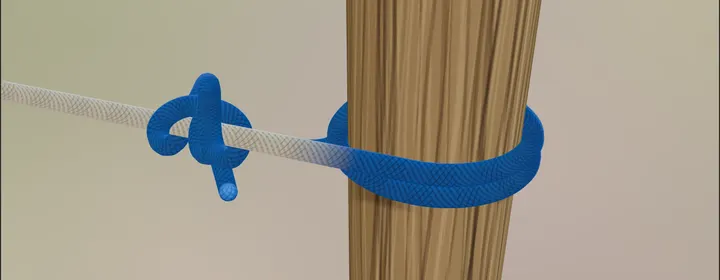 Technique 3Round turn and two half hitchesTwo turns round a post, piling, rail or ring, then two half hitches round the standing part: a secure tie that can be started while the line is already pulling.4 steps
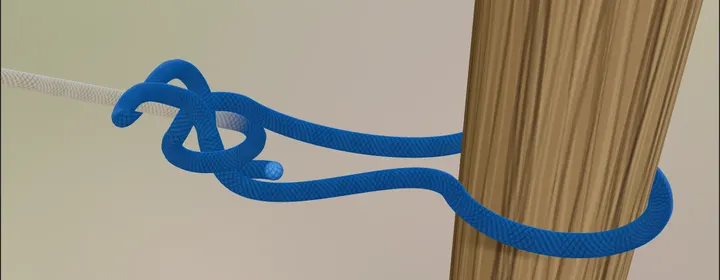 Technique 4BowlineA fixed loop in the end of a line that will not slip or jam and unties easily, even after a heavy load. Here, dropped over a piling.5 steps
Learn it hands-on
Nothing beats a day on the water with someone who ties these every trip. Browse charter and lesson operators near you and ask them to show you.
Find charters and lessonsSources
Where the checkable claims above come from. Rules and figures change, so confirm anything you are about to rely on against the source itself.
- Boat Crew Handbook: Seamanship Fundamentals (BCH 16114.4)U.S. Coast Guard (hosted by the Coast Guard Auxiliary) (rdept.cgaux.org)
- Marlinspike SeamanshipU.S. Army Corps of Engineers (corpslakes.erdc.dren.mil)
- Knots to Know: Cleat hitchAmerica's Boating Club (boatingcompass.org)
- How to Tie a Cleat Hitch KnotDiscover Boating (National Marine Manufacturers Association) (discoverboating.com)
- Types of Nautical Knots (Indiana Boater Safety Course)Boat Ed (Kalkomey Enterprises) (boat-ed.com)