Your dinghy is your gateway to anchoring ground and shore access. For cruisers planning extended passages, selecting between an inflatable tender and a hard dinghy ranks among the most consequential gear decisions you'll make, right up there with choosing your boat itself. The choice shapes how you explore, how much you spend, where you can anchor safely, and how much deck space you're willing to sacrifice. It's not about finding the "best" dinghy; it's about finding the one that matches your cruising style, your budget, and your tolerance for maintenance. Cruisers who've logged years coastal hopping have strong opinions on both sides, and there are legitimate tradeoffs that come with each.
Inflatable Dinghies: Lightweight and Practical
Inflatable dinghies own the cruising world for good reason, and they come in two flavors: soft inflatables (roll-up or air-floor, with no rigid hull) that pack away smallest, and RIBs (rigid inflatable boats, inflatable tubes on a fiberglass or aluminum hull) that plane and handle better at a higher price. An 8 to 12-foot soft inflatable stores compactly when deflated, lashing under a rail or into a cockpit locker. This means no davits, no permanent deck obstruction, no added windage. For cruisers on a budget, an entry-level 8-foot inflatable with a 4-6 hp outboard lands in the $2,000–$4,000 range and performs admirably for day trips and short passages to shore.
The lightweight design makes inflation, deflation, and stowage a one-person job. You can haul it aboard solo, shake water off, and pack it away in minutes. Inflatables excel in rough conditions too: their foam-filled tubes absorb impact, ride high over chop, and rarely swamp. A RIB with a fiberglass hull and rigid collar bridges the gap between a full inflatable and a hard dinghy, offering better performance and longevity, though at a premium price.
The tradeoff is complexity. Tubes require regular inspection for soft spots and micro-tears. Valves can freeze in cold water, and UV exposure degrades the material over years. Repair kits cost $50–$200, and some failures (seam leaks, fabric rot) force you to replace the tube rather than patch it. Inflatables also demand more skill to handle smartly in strong cross-currents or beam seas, they pivot quickly, and inexperienced operators can broach. Weight capacity is real; overload an inflatable even slightly, and it becomes sluggish and unreliable.
Hard Dinghies: Durability and Predictability
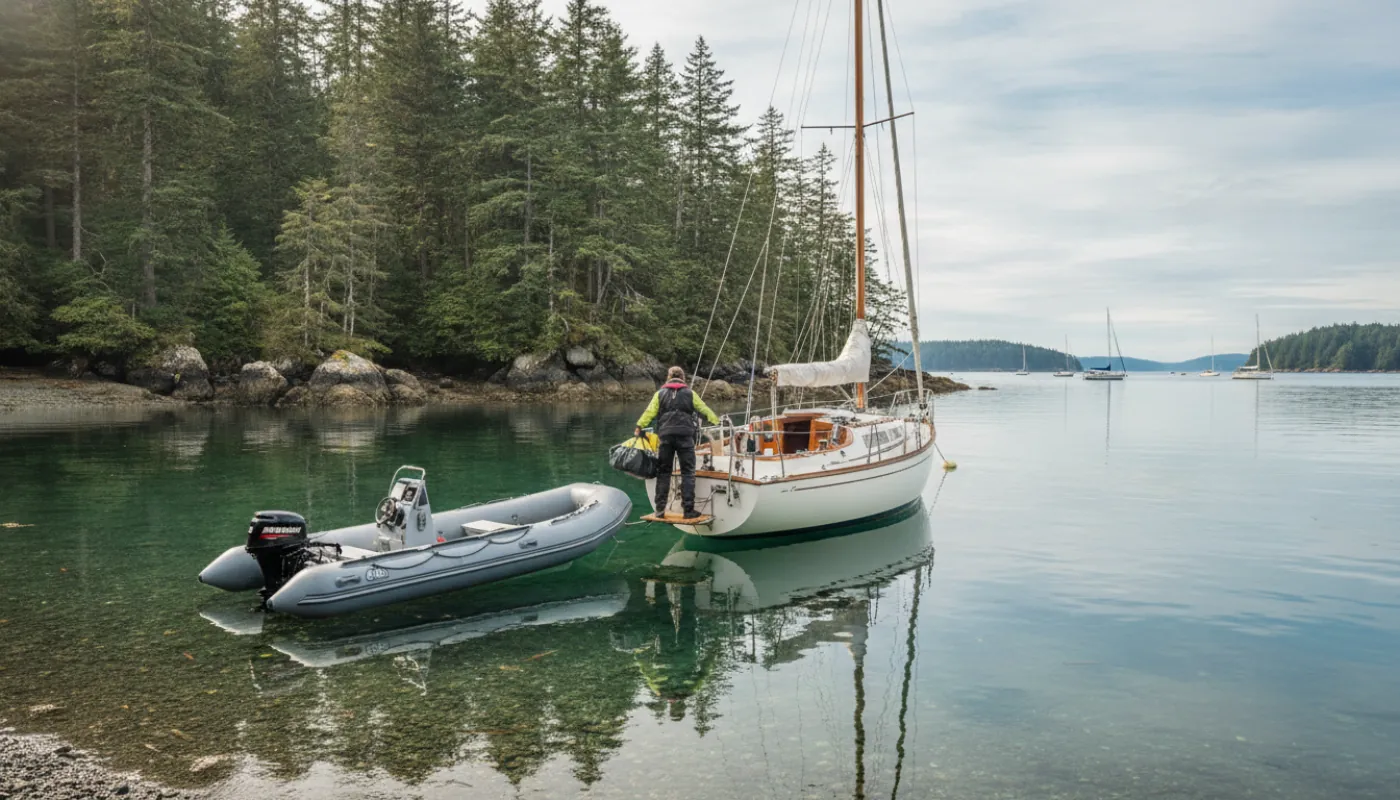
A hard dinghy, a traditional fiberglass or aluminum hull, is a small ship. Sit it behind your boat on davits, and it's always ready. Launch, retrieve, and you're done. Hard dinghies track predictably in sea state, steer intuitively, and row well if your outboard fails. A 10-foot hard dinghy glasses over waves with confidence; you're unlikely to broach, and waves shed off rather than slosh aboard.
Durability is the core appeal. A well-maintained fiberglass dinghy lasts 20+ years of cruising. Maintenance is straightforward: annual bottom paint, gel coat touch-ups, and routine hardware servicing. Unlike inflatables, hard dinghies don't degrade from UV or salt spray in the same way. They hold their value, and used 10-foot hard dinghies trade hands at $1,500–$3,000, often cheaper than a comparable inflatable when you factor in the outboard.
The cost of permanence is space. A davit system runs $1,000–$3,000 installed. The dinghy itself occupies constant deck real estate and adds windage underway. In storm conditions, that 10-foot tender hanging off stern davits becomes a liability: it swings, groans, and tempts you to cut it loose. Hauling it inboard for rough-water passages means taking up cabin or foredeck space. Hard dinghies also row heavy and require two people to lift aboard if you lose your davit system. And if your boat is small (30 feet or less), the visual proportions of a 10-foot hard dinghy can feel ungainly.
Storage, Cost, and Practical Deployment
Here's where the choice crystallizes around lifestyle. Inflatables win if you anchor frequently in tight, crowded anchorages where davits are a visual eyesore and deck clutter matters. They're the default for cruisers sleeping at anchor four nights a week. You pack it away, recover deck space, reduce topside profile, and move with minimal fuss.
Hard dinghies win if you live on moorings or in established harbors where you're never more than 50 yards from the water. The ritual of launching and securing from davits becomes routine and second nature. If you're cruising coastally, 500-mile passages with 10-day anchorage rotations, a hard dinghy's reliability and sea-handling offset the storage overhead.
Cost math matters too. A used 10-foot hard dinghy plus a used 8 hp four-stroke outboard ($1,000) totals roughly $2,500–$3,500. A modern inflatable (8–10 feet) plus a comparable outboard runs $3,000–$5,500. Fuel consumption favors neither; small outboards sip alike. Maintenance costs track differently: hard dinghies need annual haul-out, bottom paint, and gel coat work (roughly $300–$600 per year). Inflatables need tube inspections, valve maintenance, and occasional patches ($50–$200 per year) until a major repair forces replacement ($1,200–$2,500).
Over a decade, the costs align more closely than they initially appear. But the upfront capital and the psychic cost of davit installation and deck clutter matter now, when you're provisioning for your cruise.
| Inflatable (soft or RIB) | Hard dinghy | |
|---|---|---|
| Stowage | Deflate and pack away (soft) or on davits (RIB) | Davits or on deck, constant space and windage |
| Durability | ~5+ yr tubes; UV and tropics shorten it | 20+ yr fiberglass, climate-tolerant |
| Rowing / sea-handling | Rides chop high but can broach; rows poorly | Tracks and rows well; sheds waves |
| Field repair | Glue a patch at anchor | Needs a haul-out for hull work |
| Upfront cost | $3,000–$5,500 (inflatable + outboard) | ~$2,500–$3,500 (used dinghy + outboard + davits) |
| Best for | Frequent anchoring, tight or crowded coves | Moorings and harbors, long-term cruising programs |
Maintenance, Durability, and Cruising Season Length
Extended cruising reveals maintenance fault lines. Inflatable tubes exposed to year-round sun, particularly in tropical latitudes, degrade faster than northern-season cruisers assume. Five years is not uncommon for the first significant tube degradation. Fiberglass hard dinghies are less fussy about climate. A hard dinghy left unattended in the Mediterranean for six months returns intact; an inflatable left equally unattended may develop soft spots.
Outboard reliability doesn't split cleanly. A 4-stroke outboard on an inflatable serves the same years as one powering a hard dinghy. But the inflatable's lighter weight magnifies even small outboard issues, a worn lower unit carb adjustment is noticeable where a hard dinghy would mask it. Four-stroke outboards (now the default, since emissions rules pushed new-engine production away from carbureted two-strokes, and a handful of freshwater lakes ban older two-strokes outright) cost more upfront but demand less maintenance and run cheaper on fuel.
For season-long or year-round cruising, hard dinghies demand more attention to bottom paint and corrosion but ask less of your daily worry budget. You don't scan the tubes for leaks or check valve condition. Inflatables reward careful protocol (regular tube checks, UV covers, off-season deflation storage), and punish neglect. A rig where you're anchored for weeks at a time in bright sun and hot water benefits from a hard dinghy's passivity.
If you're trading boats frequently or cruising for only 4–6 months per year, the inflatable's compactness and lower total cost make sense. If you're settled into a long-term cruising program (3+ years), a hard dinghy's durability and predictability justify the space.
Making Your Call: Matching Tender to Cruising Pattern
The right dinghy is not the best dinghy, it's the one that matches how you actually spend your time on the water. Ask yourself three questions honestly.
First: Will you anchor frequently in crowded, photogenic anchorages where you want to minimize your visual footprint and deck clutter? If yes, an inflatable trades durability for flexibility and aesthetics. Many Caribbean and Mediterranean cruisers make this tradeoff without regret.
Second: Will you spend 70% of your time on a mooring, at a dock, or in established anchorages? A hard dinghy's permanence becomes a net gain. You're rarely more than a few minutes from the water, and the davit system becomes invisible routine.
Third: How much budget and DIY tolerance do you have? Inflatables are cheaper entry and simpler to field-repair (you can glue a patch at anchor). Hard dinghies cost more and demand professional haul-out work. If you're working with a tight budget or you're not comfortable raising your boat to service the bottom, an inflatable's lower service ceiling matters.
The middle road, a RIB with a fiberglass hull and decent tube quality, bridges both camps at a premium price. Many experienced cruisers land here after a decade of trial and tradeoff. But for your first dinghy, start with honesty about where your boat will spend its time. That answer is worth more than any specification sheet.